
Grid-Enhancing Technologies
Dynamic Line Rating (DLR)
Real-time capacity for the transmission lines you already own
Dynamic line rating replaces worst-case assumptions with live conductor and weather data, so operators know what each transmission line can safely carry right now.
This guide explains how DLR works, where it pays off, what regulators require, and how the PowerDonut® delivers it.
What is dynamic line rating?
Dynamic line rating (DLR) is the continuous calculation of the maximum current an overhead power line can safely carry, using real-time weather (wind, air temperature, solar radiation) and conductor measurements (temperature, sag, tension or clearance) instead of fixed worst-case assumptions. Because real conditions are usually more favorable than the worst case, DLR typically unlocks additional capacity on existing lines—and warns operators when capacity is lower than assumed.
DLR is also called real-time thermal rating (RTTR) or dynamic thermal rating (DTR). It is one of the grid-enhancing technologies (GETs), a family of sensors, software and power electronics that get more out of the existing transmission network.
Why static line ratings leave capacity unused
Every overhead conductor has a thermal limit. As current flows, resistive heating raises the conductor's temperature; the metal expands and the line sags. If it sags too far, it can violate ground or vegetation clearances and flash over, and sustained overheating can permanently damage (anneal) the conductor. The line rating exists to prevent both.
A static line rating (SLR) is calculated once, assuming that the worst cooling conditions all happen at the same time: a hot day, strong sun and almost no wind blowing nearly parallel to the conductor. That combination is rare. For most hours of the year the line could carry more current without exceeding its temperature or clearance limits, but the static rating does not change.
Wind is the biggest variable. Even a light breeze blowing across a conductor removes far more heat than the near-still air assumed in a static rating, which is why ratings based on measured conditions are frequently well above the static value—and occasionally below it on hot, still days.
Line rating methods compared: SLR, SAR, AAR and DLR
| Method | What changes | Update frequency | Wind assumption | Typical use |
|---|---|---|---|---|
| Static (SLR) | Nothing — one worst-case value | Fixed | Very low, near-parallel | Legacy default |
| Seasonal (SAR) | Temperature assumption per season | 2–4 times a year | Very low, fixed | Common utility practice |
| Ambient-adjusted (AAR) | Forecast air temperature; day/night solar | At least hourly | Still fixed and conservative | Required by FERC Order No. 881 for near-term service |
| Dynamic (DLR) | Actual wind, temperature, solar and/or measured conductor state | Real-time (seconds to minutes) plus forecasts | Measured or forecast | Congested, thermally limited lines; renewable corridors |
AAR is a meaningful improvement over static ratings, but because it keeps a fixed low-wind assumption, it cannot capture the largest source of extra capacity. DLR can.
How dynamic line rating works
The conductor heat balance
DLR is built on a simple physical balance. At any moment, the heat entering the conductor must equal the heat leaving it:
The two reference methods for this calculation are IEEE Std 738(current edition 2023) and CIGRE Technical Brochure 601. Both take conductor properties, weather inputs and a maximum operating temperature and return the allowable current. Studies comparing the two on the same line have found meaningful differences in the resulting ratings, so the chosen method and its inputs should be documented and consistent.
From measurement to the control room
- Measure. Sensors on the conductor and weather stations along the corridor record current, conductor temperature, inclination (sag), wind, ambient temperature and solar radiation.
- Calculate. Software applies the heat balance to each monitored span and takes the most limiting span as the rating for the line section.
- Forecast. Operators and markets need ratings ahead of time, so real-time values are combined with weather forecasts to produce hour-ahead and day-ahead ratings with appropriate confidence margins.
- Deliver. Ratings flow to the EMS/SCADA and, in organized markets, to the RTO/ISO, where they set the limits used for dispatch and congestion management.
Direct vs. indirect dynamic line rating
Direct (sensor-based) DLR
Devices attached to the conductor measure its real state — temperature, sag, tension or clearance. The rating reflects what the line is actually doing, including local effects that weather models miss. CIGRE Technical Brochure 498 is the dedicated guide for these direct real-time monitoring systems.
Indirect (weather-based) DLR
Weather stations or numerical weather models feed a thermal model to estimate the rating, without contacting the line. It scales easily, but the result is only as good as the weather inputs at the most critical spans, where wind is often sheltered by terrain or vegetation.
Atecnum offers both methods: PowerDonut® conductor sensors for direct DLR and Atecnum weather stations for weather-based DLR, combined in the PDS20 software. In practice, the strongest systems are hybrid: weather data provides forecasting and corridor coverage, while conductor sensors at critical spans verify that the model matches the line's real temperature and sag. FERC noted in its 2024 DLR rulemaking that reflecting wind conditions likely requires sensors, and a 2025 academic review points out that weather changes along a line while the rating is set by its most limiting span — which is why measured feedback from the conductor matters for operator confidence.
Benefits of dynamic line rating
More capacity from existing assets
The U.S. DOE reports that DLR increases effective capacity by an average of 10–30%, at less than 5% of the cost of rebuilding the line.
Lower congestion costs
Higher, accurate ratings on binding constraints let cheaper generation reach load, reducing congestion and redispatch payments that end up on customer bills.
Renewable integration
When wind farms produce the most, the same wind cools nearby lines. DLR captures that extra headroom exactly when it is needed, reducing curtailment.
Reliability and safety
Real-time conductor temperature and sag give operators situational awareness, flag lines with less margin than assumed, and support clearance compliance.
Speed
Sensors install in months, without new rights-of-way, environmental reviews or towers — a bridge while long-term transmission is built.
Better planning data
Years of measured line behavior improve rating methodologies, identify the true limiting spans and inform where reconductoring or new lines are really needed.
Dynamic line rating in the field: documented results
- PPL Electric Utilities (Pennsylvania, PJM). In October 2022 PPL began streaming dynamic ratings for three 230 kV lines to PJM, which uses them in reliability and market operations; PPL estimated about $23 million a year in congestion savings. PPL reports that average normal ratings on those lines rose about 17%, and that congestion costs on the Juniata–Cumberland line fell from more than $60 million in winter 2021–22 to about $1.6 million in winter 2022–23.
- PJM during Winter Storm Elliott. PJM told FERC that dynamic ratings on PPL's lines came in above the ambient-adjusted ratings during the storm, avoiding redispatch — while cautioning that station upgrades and congestion management on nearby facilities also played a part, and that its DLR experience is still a small sample.
- U.S. DOE field data. In its 2019 report to Congress, DOE compiled utility results such as Oncor (30–70% above static ratings), NYPA (30–44%) and AltaLink in Canada (an average 22% increase over static ratings, 76% of the time).
- EPE (Brazil). Brazil's energy planning agency recommended DLR for the 138 kV Mogi Guaçu–São João da Boa Vista II line in São Paulo state: an estimated R$2.1 million investment raising the normal limit from 79 to 95 MVA (about 20%) and postponing a roughly R$140 million rebuild beyond 2038.
A note on expectations: the headline results come from well-chosen, heavily congested lines, and DOE cautions that outcomes are difficult to extrapolate beyond the targeted lines. Benefits vary by line, weather and market. A screening study is the best way to estimate value before committing to a fleet-wide rollout.
Dynamic line rating regulation and policy
United States
- FERC Order No. 881 (2021) requires ambient-adjusted ratings for near-term transmission service and requires RTOs/ISOs to have systems that can accept dynamic ratings from transmission owners that choose to use them. The original July 2025 deadline was extended for several operators: PJM became the first RTO to implement AAR on March 4, 2026, while FERC gave MISO and NYISO until no later than December 31, 2028.
- FERC DLR rulemaking (RM24-6). In 2024 FERC issued an advance notice of proposed rulemaking on DLR, exploring requirements to reflect solar heating and forecast wind conditions on certain lines. As of FERC's August 2026 regulatory agenda, no proposed or final DLR rule had been issued.
- FERC Order No. 1920 (2024) requires transmission providers to consider more fully dynamic line ratings, advanced power flow control, advanced conductors and transmission switching in long-term regional transmission planning. Order No. 1920-A (November 2024) left that requirement in place.
Europe and Latin America
The EU Action Plan for Grids (November 2023) makes better use of existing grids one of its core challenges and names dynamic line rating among the innovative solutions for network efficiency. In Latin America, where renewable generation is outpacing transmission, Brazil's planning agency EPE has recommended DLR as a lower-cost way to add capacity and defer rebuilds.
Which lines benefit most from DLR?
DLR adds value where a line's thermal rating is the binding limit. Prioritize lines that are:
- Frequently congested or binding in market results, with measurable congestion cost.
- Near wind generation or in naturally windy, exposed corridors.
- Constraining interconnection of new generation or large loads such as data centers.
- Scheduled for costly reconductoring or rebuild that DLR could defer.
- Short to medium length, where thermal limits — not voltage or stability limits — set transfer capability.
DLR will not help where the limit is set by substation equipment (breakers, CTs, wave traps), voltage stability or protection settings. Those elements should be reviewed during screening.
The PowerDonut® dynamic line rating solution
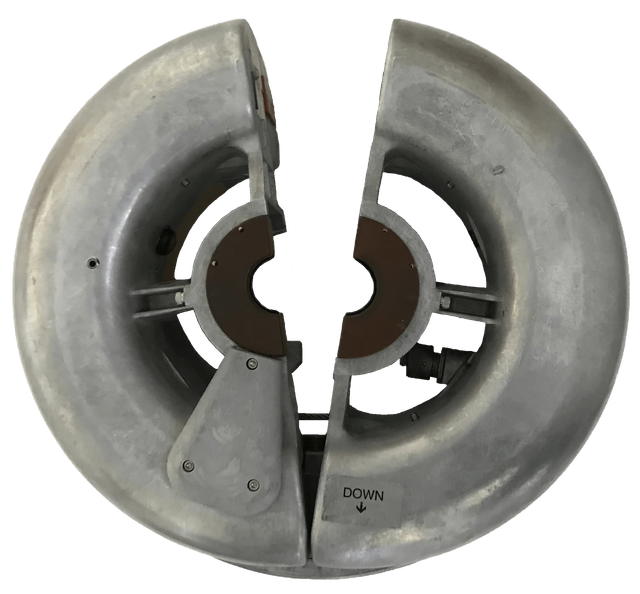
The PowerDonut® has been used for overhead line monitoring since the 1980s, when it was developed by Niagara Mohawk (now National Grid). Atecnum acquired the complete PowerDonut® business from USi in 2018 and manufactures the fourth-generation PD4 in the U.S.A.
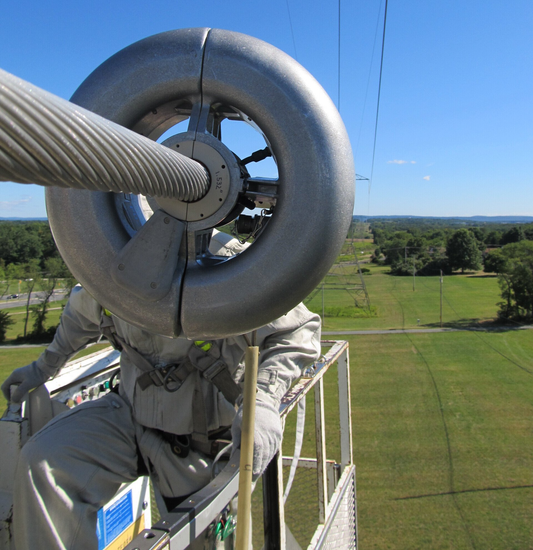
It is a direct DLR sensor: it clamps onto the energized conductor and measures the line's real temperature, current and inclination (used to calculate sag and tension). Combined with Atecnum weather stations and the PDS20 software, it delivers a complete hybrid DLR system.
PowerDonut® PD4 key specifications
| Measurement | Range | Accuracy |
|---|---|---|
| Current | 0 to 3,000 A | ±0.5% |
| Voltage | 0 to 765 kV | ±2.5% |
| Conductor temperature | −40 °C to +250 °C | ±0.05 °C |
| Inclination angle (sag & tension) | −11° to +11° | ±0.05° |
| Operating temperature | −40 °C to +60 °C | — |
- Self-powered from the conductor's magnetic field, with a programmable backup battery for up to 12 hours below 50 A.
- Live-line installation on 50 Hz and 60 Hz systems.
- Additional measurements: frequency, watts, VArs and voltage/current phase angle; optional harmonics up to the 31st and fault waveform capture.
- Resilient communications: 2.4 GHz XBee radio plus CAT-M1/NB-IoT cellular, with about one month of on-board storage that back-fills when communications return.
PDS20 DLR software
PDS20 receives data from PowerDonuts® and weather stations, computes dynamic line ratings, sag and tension, and raises alarms when thresholds are exceeded. Polling intervals start at 5 seconds; history is stored in SQL with scheduled CSV export; and data can be integrated with EMS and SCADA systems on local, server-to-server or cloud architectures, with secure access from computers, tablets and phones.
How a DLR project is deployed
- Screen the network. Rank lines by congestion cost, thermal binding hours, wind exposure and pending upgrades.
- Identify critical spans. Use line surveys and clearance data to find the spans most likely to limit the rating.
- Install sensors and weather stations. PowerDonuts® are clamped on the energized line; no outage or new structures are required.
- Commission and validate. Compare measured conductor temperature and sag with model results; tune the rating methodology.
- Integrate into operations. Deliver real-time and forecast ratings to EMS/SCADA and, where applicable, the RTO/ISO.
- Measure value and scale. Track rating gains and congestion savings, then extend to the next constrained corridors.
Dynamic line rating FAQ
What is dynamic line rating (DLR)?
Dynamic line rating is the continuous calculation of how much current an overhead transmission line can safely carry, based on real-time weather and conductor conditions instead of fixed worst-case assumptions. Because actual conditions are usually cooler and windier than the worst case, DLR typically reveals additional capacity on existing lines.
How much capacity can dynamic line rating add?
The U.S. Department of Energy reports that DLR increases effective transmission capacity by an average of 10–30%. Results depend on the line, its location and the weather; at times DLR can also show less capacity than the static rating, which is a safety benefit.
What is the difference between AAR and DLR?
Ambient-adjusted ratings (AAR) update the line rating at least hourly using forecast air temperature and day/night solar conditions, but keep a conservative fixed wind assumption. Dynamic line ratings also account for actual wind, solar radiation and, with direct sensors, the conductor's measured temperature, sag or tension.
Is dynamic line rating required by FERC?
Not yet. FERC Order No. 881 requires ambient-adjusted ratings, not DLR, and requires RTOs/ISOs to be able to accept dynamic ratings. FERC opened a DLR rulemaking (RM24-6) in 2024, but no proposed or final rule had been issued as of August 2026. Order No. 1920 requires transmission providers to consider DLR in long-term regional planning.
What is the difference between direct and indirect DLR?
Direct DLR uses sensors attached to the conductor to measure its actual state, such as temperature, sag, tension or clearance. Indirect DLR estimates the rating from weather measurements or forecasts and a thermal model. Many utilities combine both: weather data for forecasting and conductor sensors to verify the line's real behavior at critical spans. Atecnum offers both, with PowerDonut® conductor sensors and weather stations integrated in the PDS20 software.
Which standards are used to calculate dynamic line ratings?
The two main references for the conductor heat-balance calculation are IEEE Std 738 and CIGRE Technical Brochure 601. CIGRE Technical Brochure 498 provides guidance on direct real-time monitoring systems that measure conductor sag, tension or temperature.
Can PowerDonut® sensors be installed on energized lines?
Yes. The PowerDonut® PD4 is designed for installation on live lines, works on 50 Hz and 60 Hz systems, and is self-powered by the magnetic field around the conductor, with a programmable backup battery for low-load periods.
How long does a DLR deployment take?
PPL Electric reports that implementing DLR on a line takes about a year, compared with 2–3 years to reconductor and 3–5 years to rebuild. Full integration into control-room and market operations can take longer: PPL's first project ran from 2020 to late 2022.
Find the hidden capacity in your lines
Tell us which corridors are congested. We'll help you scope a PowerDonut® DLR pilot.
Related resources
Sources
- U.S. Department of Energy, Dynamic Line Rating — Report to Congress(June 2019).
- FERC, Order No. 881 news release(2021).
- PJM Inside Lines, PJM Becomes First RTO to Implement Ambient-Air Ratings Under FERC Order 881(March 2026).
- FERC, Order granting MISO extension of time under Order No. 881(2025).
- FERC, Order granting NYISO extension of time, Docket ER22-2350(March 2024).
- Federal Register, Implementation of Dynamic Line Ratings (ANOPR, RM24-6)(July 2024).
- Federal Register, FERC Unified Regulatory Agenda(August 2026).
- Federal Register, Order No. 1920-A, Building for the Future Through Electric Regional Transmission Planning and Cost Allocation(December 2024).
- PJM Inside Lines, Dynamic Line Rating Activated by PPL Electric Utilities(October 2022).
- E. Rosenberger, PPL Electric Utilities, PPL Electric's Dynamic Line Ratings (DLR), Energy Association of Pennsylvania conference (October 2024).
- PJM Interconnection, Comments on the DLR ANOPR, Docket RM24-6(October 2024).
- Canal Solar, EPE recommends DLR to expand transmission in São Paulo.
- European Commission, EU Action Plan for Grids, COM(2023) 757(November 2023).
- CIGRE, TB 498: Guide for Application of Direct Real-Time Monitoring Systems.
- Peña, Colmenar-Santos & Rosales-Asensio, Dynamic Line Rating: Technology and Future Perspectives, Electronics 14(14) (2025).
- Atecnum, PowerDonut® PD4 and PDS20 Software product specifications.
