
History and Impact of the PowerDonut
Unlocking Grid Capacity and Modernizing Transmission Infrastructure with Dynamic Line Rating
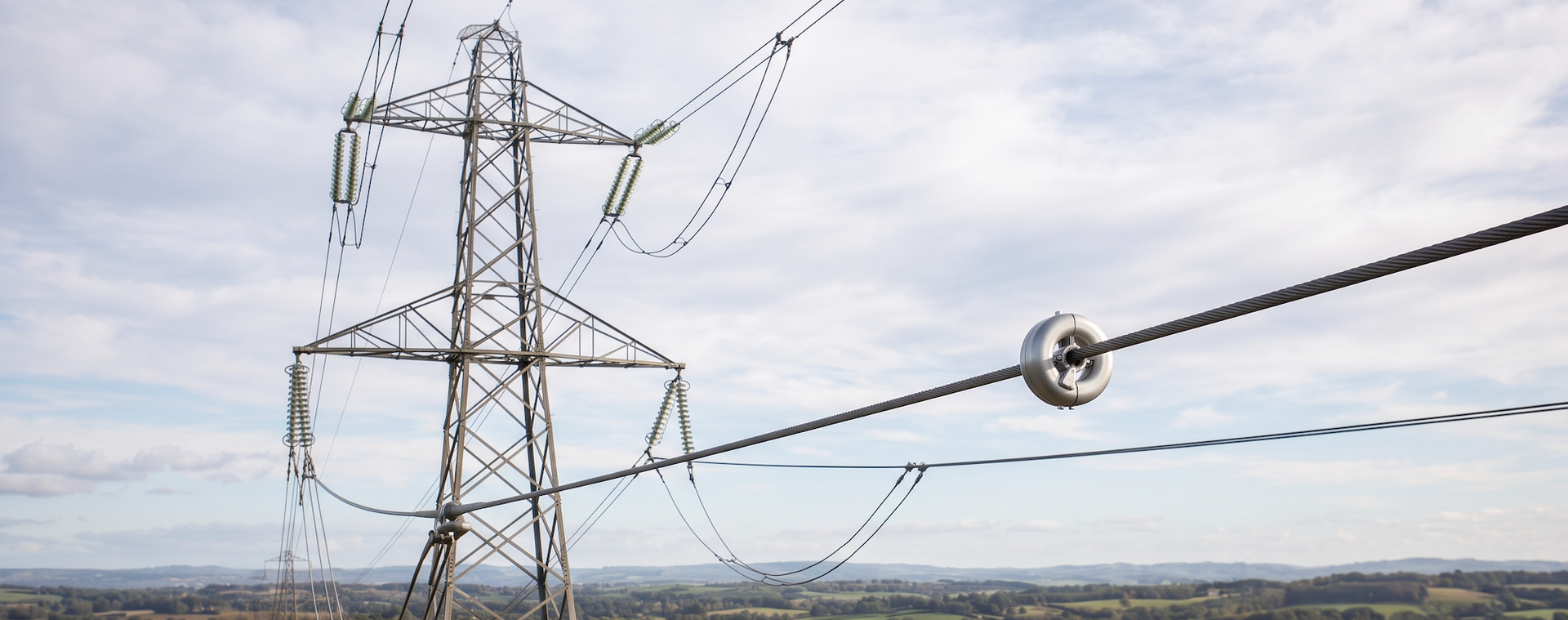
The PowerDonut® (often stylized as Power Donut and Power-Donut) is a clamped-on intelligent electronic device (IED) and smart sensor used on high-voltage overhead electrical transmission lines. Its primary function is to measure real-time conditions of power lines, enabling a practice known as Dynamic Line Rating (DLR). By monitoring live environmental and physical data—such as conductor temperature, sag, and current—the device allows grid operators to safely increase the transmission capacity of existing electrical infrastructure without requiring the need to construct new ones.
History and Development
The PowerDonut® was originally invented and developed in the 1980’s by Niagara Mohawk (now National Grid). The product line was later purchased by Underground Systems Inc. (USi), a technology company based in Armonk, New York. It was introduced as one of the earliest pioneering devices for real-time overhead transmission line monitoring.
The methodology underlying the sensor's function—specifically calculating real-time conductor sag and clearance limits using line inclination and temperature. Over the decades, the device has undergone multiple technological improvements. Early models relied on basic radio transmitters, while modern versions (such as the Fourth Generation "PD4") incorporate advanced cellular networks like (CAT-M1) and Radio communications, as well as lower start-up current requirements.
Today, the PowerDonut® is manufactured in the U.S.A. and is owned by Atecnum Corporation, headquartered in Boynton Beach, Florida. The company has multiple active patents for this technology in the U.S.A. and in many other countries.
Function and Operation
The PowerDonut® is designed to operate in extreme, high-voltage environments, clamping directly onto uninsulated transmission lines carrying up to 765,000 volts.
Self-Powering Mechanism
A defining feature of the PowerDonut® is its ability to operate indefinitely without external power or frequent battery replacements. It achieves this by utilizing an internal Rogowski coil, which harvests energy directly from the magnetic field generated by the alternating current (AC) flowing through the transmission line. It also contains a programmable backup battery that can provide up to 12 hours of power when the line load drops below 50 Amps.
Technical Specifications
The device acts as a ruggedized edge-computing hub, measuring multiple variables simultaneously:
- Current: Measures from 0 to 3,000 Amps with high accuracy (+/- 0.5%).
- Voltage: Operates on lines from 0 to 765 kV.
- Temperature: Monitors internal conductor temperatures ranging from -40°C to 250°C (up to 482°F).
- Inclination (Sag): Features an inclinometer to measure the line's droop angle from -11° to 11°, critical for calculating how close the high-voltage line is sagging toward the ground.
Data is transmitted to grid control centers via dual communication modules (2.4 GHz XBEE radio and CAT-M1 cellular) and integrated into SCADA systems.
Applications and Value
The PowerDonut® sits within a rapidly expanding sector of the power industry known as Grid Enhancing Technologies (GETs). Its deployment primarily aims to solve the "Static Line Rating" bottleneck.
Overcoming Static Line Ratings (SLR)
Historically, electrical grids operate using Static Line Ratings—a fixed maximum capacity based on worst-case weather estimates (e.g., a hot, windless summer day). Because real-world weather usually provides more cooling than the worst-case scenario, transmission lines typically operate well below their actual physical capacity. The PowerDonut® facilitates Dynamic Line Rating (DLR), updating the line's safe capacity based on real-time cooling effects from ambient wind and temperature. This allows utilities to push 15% to 40% more electricity through the same wires safely.
Renewable Energy Integration
The intermittent nature of renewable energy, particularly wind power, often causes sudden congestion on the power grid. Conveniently, when a wind farm generates its maximum output, that same wind effectively cools the local transmission lines. Sensors like the PowerDonut® detect this cooling in real-time, instantly unlocking additional capacity exactly when the renewable energy needs to be transported, thereby preventing the waste (curtailment) of clean energy.
Safety and Disaster Prevention
When transmission lines carry heavy electrical loads, the metallic conductors heat up and expand, causing the lines to sag. If a high-voltage line sags too close to trees or structures, the electricity can arc, potentially causing massive wildfires or triggering cascading grid blackouts (such as the Northeast blackout of 2003). By continuously monitoring the exact inclination and temperature of the wire, the PowerDonut® provides grid operators with an early warning system to reroute power before catastrophic sagging occurs.
Grid Aging Economic Impact
Grid congestion costs consumers billions of dollars annually because utilities must purchase expensive local power when cheaper, distant power is blocked by transmission bottlenecks. Upgrading the grid using Dynamic Line Rating sensors is highly cost-effective compared to traditional infrastructure projects. This is critical considering the massive new data center power requirements in today’s AI world.
- Cost: Outfitting lines with DLR sensors costs approximately 20% of the cost of building new high-voltage transmission lines.
- Deployment Speed: Installing a network of PowerDonuts® takes months and avoids the extensive land rights, environmental reviews, and public opposition (NIMBYism) associated with building new towers. In contrast, new transmission lines can take 7 to 10 years to permit and construct.
While devices like the PowerDonut® do not permanently replace the eventual need for new power lines, they are considered a vital bridge technology—squeezing maximum efficiency out of existing infrastructure while long-term grid expansions are planned.[9]
